

ABSTRACT
WebGIS systems have been leveraged to enhance aquaculture management and reduce reliance on traditional fishing methods. The Department of Fisheries Malaysia developed BioDOF-Map, a Web-GIS system, and examined its adoption using the Theory of Planned Behavior (TPB). A descriptive survey design was used with 278 respondents. The majority of respondents were aged 36-45 years (36.7%), male (88.5%), married (51.4%), Malay (63.7%), and Muslim (66.2%). Most had secondary school certificates (55.4%), 16-20 years of farming experience (43.5%), earned between RM1,000 and RM5,000 (60.8%), and were landlords (65.8%). A significant portion (65%) engaged in off-farm jobs such as livestock, poultry, crop, vegetable, and tree crop production within 2-3 kilometers of their homes. The overall mean intention to adopt the BioDOF-Map system was high (mean = 4.55, SD = 0.296). Correlation analysis revealed significant relationships between attitude and intention to adopt (r=0.980, p<.001), subjective norms and intention to adopt (r=0.325, p<.001), and perceived behavioral control and intention to adopt (r=0.966, p<.001). These findings indicate that improving subjective norms and perceived behavioral control could enhance adoption intentions, offering valuable insights for policy development by the Ministry of Agriculture and Food Security.
Keywords: WebGIS system; BioDOFMap; Theory of Planned Behaviour; off-farm employment.
Introduction
Technology plays a crucial role in advancing both agriculture and commerce. Lieder & Schröter Schlaack (2021) describe smart farming as the integration of technologies such as agricultural automation, robotics, precision agriculture, and management information systems. The integration of ICT in smart farming has ignited what is termed the Third Green Revolution. The Fisheries Biosecurity Control Management System (BioDOF-Map), a web-based Geographic Information System (GIS), was developed by the Department of Fisheries (DOF) and the Malaysian Fisheries Agency (MYSA) using internal expertise without incurring additional government expenditure. This study utilizes the Theory of Planned Behaviour (TPB) to investigate the attitudes, subjective norms, and perceived behavioural control of Malaysian aquaculture ornamental fish producers regarding their adoption of the BioDOF-Map system. TPB, which encompasses various human behaviours, including the use of Information Technology (Ajzen, 1991; 2002), serves as a foundation for this research. The study aims to examine farmers’ intention to adopt BioDOF-Map by assessing their sociodemographic profiles and spatial characteristics, attitudes, subjective norms, and perceived behavioural control. Additionally, it seeks to establish the relationship between these factors and their influence on farmers’ intention to adopt the system.
Materials and Method
This study utilized a quantitative approach with questionnaire surveys directed at ornamental aquaculture farmers in Malaysia, ensuring representativeness through simple random sampling. The structured questionnaire featured dichotomous and multiple-choice questions across five categories: demographics (14 questions), adoption perceptions of BioDOF-Map (1 contingency question and 12 adoption intention questions), adoption perspectives (12 questions), subjective norms (9 questions), and perceived behavioral control (7 questions). Secondary data from various studies, articles, and government publications focused on off-farm employment and rural poverty, particularly from the Department of Fisheries, complemented the GIS data collected for geographical analysis. The study aims to thoroughly understand factors influencing BioDOF-Map adoption among ornamental aquaculture farmers. Analysis of socioeconomic and spatial factors impacting agricultural system development was conducted. Longley et al. (2015) emphasized the importance of geographic data, and integrating spatial and non-spatial data is essential for understanding farming populations (K.C, 2005). Data were analyzed using SPSS 25.0, with descriptive statistics applied. Objectives included spatial analysis for Objective 1 and descriptive, spatial, and correlation analyses for Objectives 2 and 3. Hypotheses were tested at a 0.01 significance level, and geographic analysis was performed using ArcGIS.
Results and Discussion
The study found that most Malaysian Aquaculture Farmers (MAFs) begin farming at a young age, with the majority aged between 46 and 55, while fewer engage in farming after 56, reflecting age-related limitations as suggested by Shephard (1987). Educational levels among respondents varied, with secondary school graduates comprising the largest group (55.4%), followed by primary school attendees (38.1%), diploma holders (4.3%), and those with a first degree (2.2%). Education is recognized as a key factor in improving farmers’ knowledge, skills, and living standards (Yassin et al., 2012). The participants’ farming experience ranged from 1 to 26 years, with 43.5% having 16-20 years of experience. Despite youth making up 44% of Malaysia’s population, only 15% are employed in agriculture (Bernama, 2021). Income levels among respondents varied, with most earning between RM1,000 and RM5,000. This aligns with Constanza et al. (2021), who found that aquaculture interventions increase income and production value. Regarding land ownership, 65.8% of respondents were landlords, 21.6% were both landlords and tenants, 12.2% were tenants, and 0.4% were workers. This supports findings by Pochanasomboon et al. (2020), which indicate that full land ownership improves yields on small and medium-sized farms.
Table 1. Demographic Characteristics and Farm Profile of the Respondents
| Demography | Category | Frequency | Percentage |
| Age | 26-35 years old | 55 | 19.8 |
| 36-45 years old | 102 | 36.7 | |
| 46-55 years old | 100 | 36.0 | |
| 56 & above years old | 21 | 7.6 | |
| Total | 278 | 100 | |
| Gender | Male | 246 | 88.5 |
| Female | 32 | 11.5 | |
| Total | 278 | 100 | |
| Marital Status | Married | 143 | 51.4 |
| Single | 132 | 47.5 | |
| Divorced/Separated | 2 | 0.7 | |
| Widow | 1 | 0.4 | |
| Total | 278 | 100 | |
| Race | Malay | 177 | 63.7 |
| Chinese | 78 | 28.1 | |
| Indian | 4 | 1.4 | |
| Others | 3 | 1.1 | |
| Bumiputera | 16 | 5.8 | |
| Total | 278 | 100 | |
| Religion | Muslim | 184 | 66.2 |
| Christian | 37 | 13.3 | |
| Buddha | 56 | 20.1 | |
| No religion | 1 | 0.4 | |
| Total | 278 | 100 | |
| Level of Education | Never attend school | 0 | 0 |
| Primary school certificate | 106 | 38.1 | |
| Secondary school certificate | 154 | 55.4 | |
| Diploma | 12 | 4.3 | |
| First degree | 6 | 2.2 | |
| Higher degree | 0 | 0 | |
| Other certificate | 0 | 0 | |
| Total | 278 | 100 | |
| Years of Farming Experience | Less than 10 years | 20 | 7.2 |
| 11-15 years | 38 | 13.7 | |
| 16-20 years | 121 | 43.5 | |
| 21 -25 years | 82 | 29.5 | |
| 26 & above years | 17 | 6.1 | |
| Level of Income per Month | Below RM1,000 | 0 | 0 |
| RM 1,001- RM 5,000 | 169 | 60.8 | |
| RM 5, 001- RM 10,000 | 103 | 37.1 | |
| RM 10,001- RM 15,000 | 6 | 2.2 | |
| RM 15,001- RM 20,000 | 0 | 0 | |
| Above RM 20,001 | 0 | 0 | |
| Total | 278 | 100 | |
| Category of farmers | Landlord | 183 | 65.8 |
| Tenant | 34 | 12.2 | |
| Landlord and Tenant | 60 | 21.6 | |
| Worker | 1 | 0.4 | |
| Other | 0 | 0 | |
| Total | 278 | 100 | |
| Type of Off Farm Activities | Marine fisheries | 1 | 0.4 |
| Aquaculture production | 0 | 0 | |
| Cage culture fisheries | 2 | 0.7 | |
| Livestock production/Poultry pro-duction | 15 | 5.4 | |
| Crop production/Vegetable produc-tion | 27 | 9.7 | |
| Tree crop production | 15 | 5.4 | |
| Other farming related practice: | 0 | 0 | |
| No off-farm activities | 218 | 78.4 | |
| Total | 278 | 100 |
Type of Off-Farm Activities of the Respondents
1 (0.4%) of the respondents are doing marine fisheries, 2 (0.7%) doing cage culture fisheries, 15 (5.4%) of the respondents do livestock production/poultry production, 27 (9.7%) of respondents in crop production/vegetable production. The rural poor who rely on non-agricultural jobs will gain from improved income prospects because of the rising demand for non-agricultural products, equipment, and consumer goods produced in rural regions in general in response to decreased food costs (Mishra and Goodwin, 1997) (Table1).
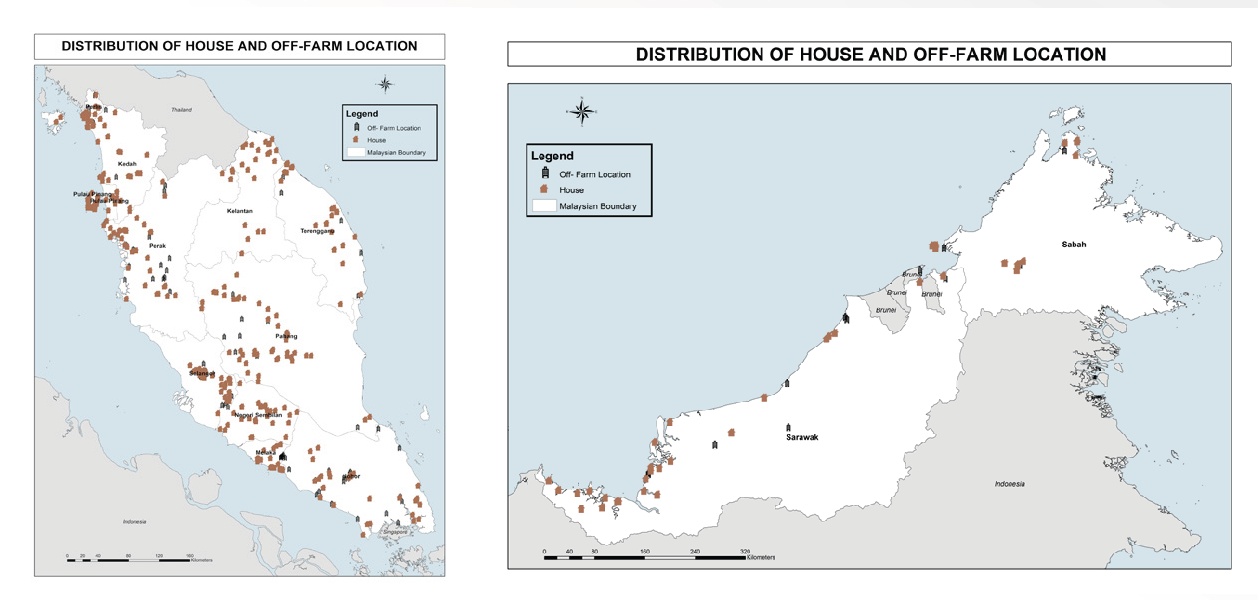
Figure 1: Distribution of House and Off-Farm Location (Peninsular Malaysia) and (Sabah and Sarawak)
Respondents’ Adoption Intention Level
The level of intention of the respondents to implement the BioDOF-Map system is displayed in Table 2. The data indicates that all of the participants (100.0%, n=278) reached a high level. Overall, the respondents’ inclination to adopt the BioDOF-Map system is assessed as high, with an average rating of 4.55 and a standard deviation of 0.296. Knickel et. al. (2017) discovered that Smart Farming Technologies (SFTs) have the potential to enhance agricultural output and sustainability by employing a more precise and resource-efficient approach.
Table 2. Level of Respondents’ Intention to Adopt
| Variables | n | % | Mean | SD | Min. | Max. |
| Level of the intention to adopt | 4.55 | .296 | 4.08 | 5.00 | ||
| Low (1.00 – 2.33) | 0 | 0.0 | ||||
| Moderate (2.34 – 3.67) | 0 | 0.0 | ||||
| High (3.68 – 5.00) | 278 | 100.0 |
Respondents’ Adoption Intention Level
The respondents’ attitude towards the intention to deploy the BioDOF-Map system is displayed in Table 3. The respondents’ attitude towards the intention to implement the BioDOF-Map system received a high score of 4.56 with a standard deviation of 0.263. Individuals’ viewpoints, societal standards, convictions, and dispositions have a substantial influence on the process of adoption (Al-Momani, et. al., 2019).
Table 3. Level of Respondents’ Attitude towards Intention to Adopt
| Variables | n | % | Mean | SD | Min. | Max. |
| Level of respondents’ attitude towards intention to adopt | 4.56 | .263 | 4.17 | 5.00 | ||
| Low (1.00 – 2.33) | 0 | 0.0 | ||||
| Moderate (2.34 – 3.67) | 0 | 0.0 | ||||
| High (3.68 – 5.00) | 278 | 100.0 |
Table 4 presents the subjective norms of respondents regarding their intention to adopt the BioDOF-Map system, showing that 100% (n=278) scored at a high level. The respondents’ subjective norms received a mean score of 4.87 and a standard deviation of 0.174. Previous studies, such as Cao et al. (2021), focused on individual interactions with online green advertisements rather than user-to-user interactions.
Table 4. Respondents’ Level of Subjective Norms towards Intention to Adopt
| Variables | n | % | Mean | SD | Min. | Max. |
| Respondents’ level of subjective norms towards intention to adopt | 4.87 | .174 | 4.44 | 5.00 | ||
| Low (1.00 – 2.33) | 0 | 0.0 | ||||
| Moderate (2.34 – 3.67) | 0 | 0.0 | ||||
| High (3.68 – 5.00) | 278 | 100.0 |
The level of perceived behaviour control of the respondent towards the intention to adopt the BioDOF-Map system is displayed in Table 5. The outcome demonstrates that 100.0% (n=278) is at the high level. In general, the respondents’ perception of behaviour control towards their intention to use the BioDOF-Map system is rated as high, with a mean score of 4.58 and a standard deviation of 0.329. Abandu et al., (2019) found that PBC has a significant role in influencing behavioural interactions related to the acceptance and use of ICT in healthcare systems.
Table 5. Level of Perceive Behaviour Control towards Intention to Adopt
| Variables | n | % | Mean | SD | Min. | Max. |
| Respondents’ level of perceived behaviour control towards intention to adopt | 4.58 | .329 | 4.00 | 5.00 | ||
| Low (1.00 – 2.33) | 0 | 0.0 | ||||
| Moderate (2.34 – 3.67) | 0 | 0.0 | ||||
| High (3.68 – 5.00) | 278 | 100.0 |
Relationship between the Respondents’ Level of Attitude, Subjective Norms and Perceived Behavioral Control and Respondents’ Intention Level to Adopt the BioDOF-Map System Table 6 demonstrates a strong, statistically significant relationship between attitude and the intention to adopt the BioDOF-Map system among Malaysian Aquaculture Farmers (MAFs), with a correlation coefficient of 0.980 and a p-value of 0.000, significant at the 0.01 level. This robust positive relationship aligns with previous research, such as Al-Subaiee et al. (2005). The study also reveals a significant correlation between subjective norms and adoption intention (correlation coefficient of 0.325, p = 0.000), indicating the influence of social norms, consistent with Tellis and Ackerman (2001). Additionally, a strong correlation between perceived behavioral control and adoption intention (r = 0.966, p = 0.000) reflects MAFs’ confidence in their ability to use the system, supporting Saga and Zmud’s (1993) findings on the importance of personal control in technology acceptance.
Table 6. Correlation between Independent and Dependent Variable (Intention)
| Independent Variables | Pearson Coefficient | P – Value |
| Attitude | 0.980** | .000 |
| Subjective Norms | 0.325** | .000 |
| Perceived Behavioral Control | 0.966** | .000 |
**. Correlation is significant at the 0.01 level (2-tailed)
Conclusions
This research reinforces previous studies on the acceptance and use of GIS systems in Malaysian aquaculture, while offering new insights into the adoption of web-based GIS systems like BioDOF-Map. Previous studies, primarily from Western contexts, established a theoretical framework linking attitude, subjective norms, and perceived behavioral control. This study confirms these relationships in Malaysia for the first time, contributing to the understanding of how information and communication technology (ICT) can enhance agricultural production and reduce poverty. The findings have significant practical implications for policymakers, suggesting strategies to increase the adoption of new technologies among aquaculture farmers through informed policy decisions and targeted outreach. Continuous review and adaptation of extension methods are recommended to improve farmers’ attitudes and motivations. Collaboration among key stakeholders, including the Ministry of Agriculture and Food Security, the Department of Fisheries Malaysia, and extension units, is essential for developing effective policies and programs that empower farmers, enhance productivity, and combat poverty. Future research should explore whether the relationships between attitude, subjective norms, and perceived behavioral control consistently predict adoption intentions across different technologies and contexts.
Acknowledgement
The authors would like to thank: YBhg. Dato’ Adnan bin Hussain, Department of Fisheries Malaysia (DOF), YBrs. Tuan Haji Wan Muhammad Aznan bin Abdullah, Department of Fisheries Malaysia (DOF), Tuan Haji Azlikamil Napiah, Malaysian Space Agency (MYSA), YBrs. Mr. Adnan Ismail, Malaysian Space Agency (MYSA). We extend our sincere gratitude to all research colleagues, field support personnel, programmers, and data processing members for their dedicated effort and commitment in this project.
References
Al-Momani, A. M., Mahmoud, M. A., & Ahmad, M. S. (2019, January 1). A Review of Factors Influencing Customer Acceptance of Internet of Things Services. International Journal of Information Systems in the Service Sector, 11(1), 54–67. https://doi.org/10.4018/ijisss.2019010104.
Al-Subaiee, S. S., Yoder, E. P., & Thomson, J. S. (2005). Extension agents’ perceptions of sustainable agriculture in the Riyadh Region of Saudi Arabia. Journal of International Agricultural and Extension Education, 12(1), 5-14.
BERNAMA. (2021, November 28). Younger Agropreneurs Needed as Agriculture Industry Evolves.
BERNAMA. https://www.bernama.com/en/business/news.php?id=2027917
Cao, X., Wu, X., & Huang, X. (2021b). How Does the Interactivity of Social Media Affect the Adoption of New Green Products? Frontiers in Psychology, 12. https://doi.org/10.3389/fpsyg.2021.786372.
Costanza, R., Kubiszewski, I., Stoeckl, N., & Kompas, T. (2021). Pluralistic discounting recognizing different capital contributions: An example estimating the net present value of global ecosystem services. Ecological Economics, 183, 106961. https://doi.org/10.1016/j.ecolecon.2021.106961,
KC, K. B. (Ed.). (2005). Combining socio-economic and spatial methodologies in rural resources and livelihood development: A case from mountains of Nepal. Wekersheim: Universität Hohenheim, Margraf Verlag.
Lieder, S., & Schröter-Schlaack, C. (2021b). Smart Farming Technologies in Arable Farming: Towards a Holistic Assessment of Opportunities and Risks. Sustainability, 13(12), 6783. https://doi. org/10.3390/su13126783.
Longley, P.A., Goodchild, M.F., Maguire, D.J. and Rhind, D.W. (2015). Geographic Information Science and Systems. John Wiley & Sons, 560.. – References – Scientific Research Publishing. (n.d.). https://www.scirp.org/reference/referencespapers?referenceid=1900296.
Mishra, A. K., & Goodwin, B. K. (1997). Farm income variability and the supply of off-farm labor.
American Journal of Agricultural Economics, 79(3), 880-887.
Pochanasomboon, A., Attavanich, W., & Kidsom, A. (2020). Impacts of Land Ownership on the Economic Performance and Viability of Rice Farming in Thailand. Land, 9(3), 71. https://doi. org/10.3390/land9030071.
Saga, V., and Zmud, R. 1994. The nature and determinants of information technology acceptance, routinization, and infusion,” in L. Levine (Ed.), Diffusion, Transfer and Implementation of Information Technology, North-Holland, 67-86.
Shephard, R. (1978). Physical activity and aging. Routledge.
Yassin et al. (2012). The quality of life and human development index of community living along Pahang and Muar rivers: a case of communities in Pekan, Bahau and Muar. Journal of Sustainable Development, 5(6), 90-103. http://dx.doi.org/10.5539/jsd.v5n6p90.