


Introduction
Service design is a multidisciplinary approach that focuses on creating optimal experiences for both customers/users and service providers. It involves the holistic design of all aspects of a service, considering the entire service journey from inception through delivery and ongoing improvement. Service Design is a process where designers create sustainable solutions and optimal experiences for both customers in unique contexts and any service providers involved. Service design aims to enhance the quality of services, improve user satisfaction, and create efficiencies for service providers. It is used across various industries, including healthcare, hospitality, finance, and retail, to innovate and deliver better experiences.
Key Principles For Service Design
- User-Centered Approach: Understanding and meeting the needs, desires, and behaviours of users/customers. Design focusing for all users.
- Holistic Perspective: Considering all touchpoints throughout user experiences and interactions across the entire service journey.
- Co-Creation: Involving all relevant stakeholders (customers, employees, etc.) in the design process to ensure their needs are met.
- Iterative Improvement: Break complex service into separate processes and user journey section, continuously refining and improving services based on feedback and data.
- Cross-Functional Collaboration: Bringing together various disciplines (design, business, technology, etc.) to create integrated and seamless services.
- System Thinking: Viewing services as interconnected systems rather than isolated components.
- Prototyping and Testing: Developing prototypes to test assumptions and gather feedback before full implementation.
Service Design vs Life Event
Service design and life events are related concepts but differ in their focus and scope. Table 1 shows the different between them.
Table 1: Service Design vs. Life Event
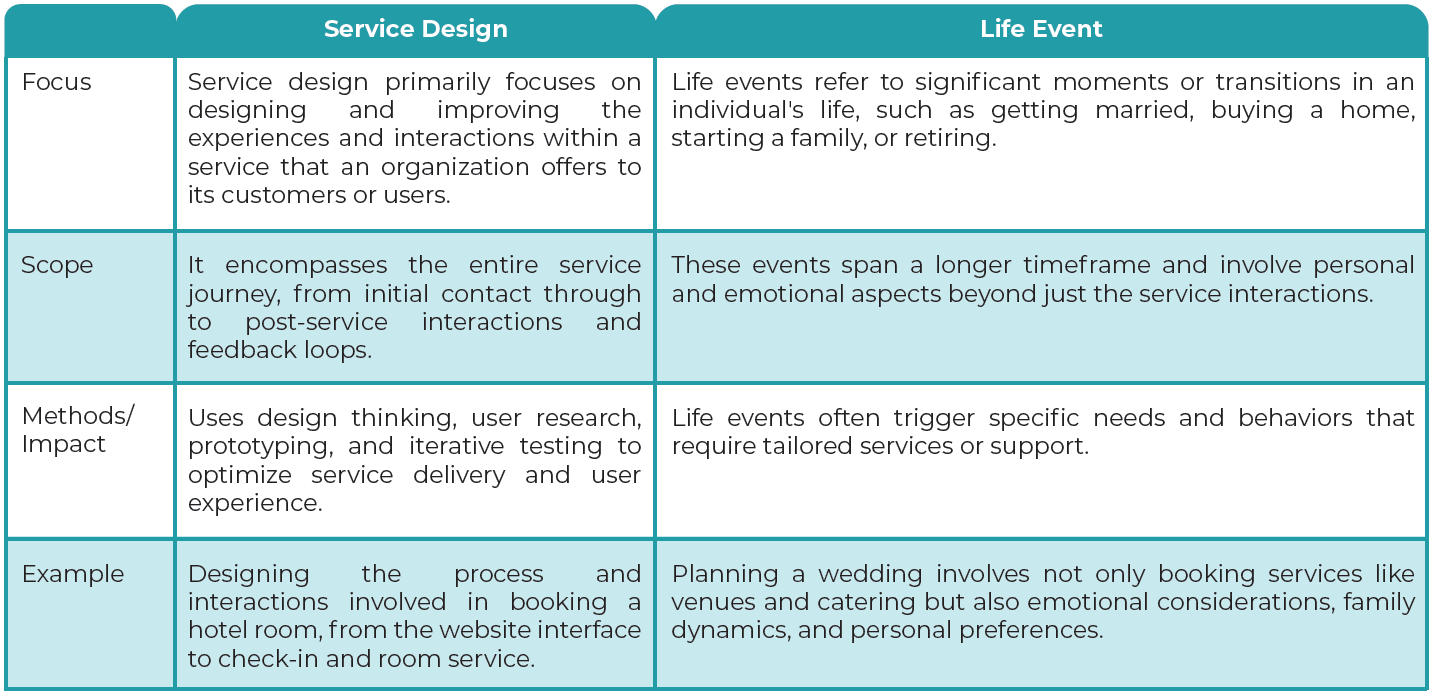
While service design can be applied to improve services related to life events (e.g., wedding planning services or retirement planning), life events themselves are broader and more encompassing, involving personal and emotional aspects that extend beyond service design principles alone. Service design focuses on optimizing the service experience within these life events, ensuring they are user-centered, efficient, and effective.
Architecture Design
When considering the relationship between service design and life events, it’s important to understand that these concepts often intersect rather than one preceding the other in a strict sequential manner. A simplified diagram illustrating the architecture design for integrating service design with life events. This diagram visualizes the key components and their relationships in creating user-centered services that support and enhance significant life events.
Diagram 1 represents a structured approach to integrating service design with life events, emphasizing user-centered design, iterative improvement, and technological integration to deliver impactful and seamless service experiences.
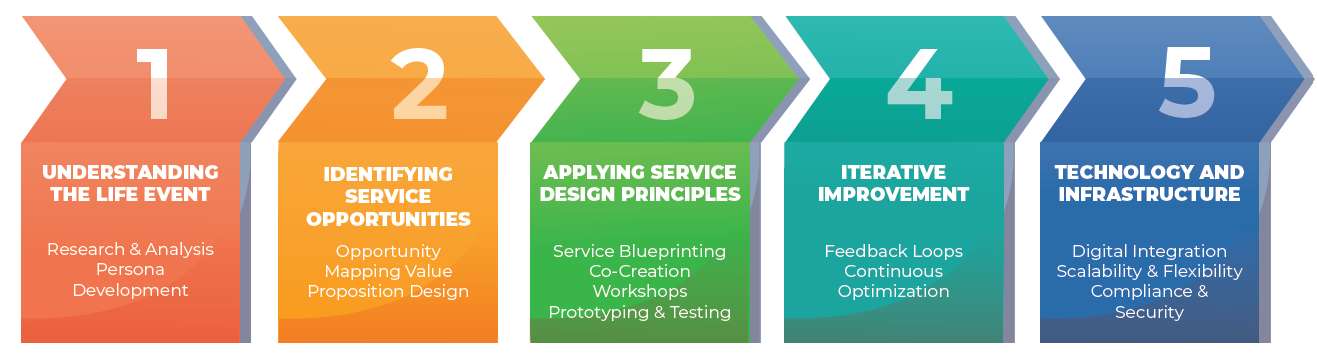
Diagram 1: Structured Approach Integrating Service Design with Life Events
- Understanding the Life Event – First and foremost, it’s crucial to deeply understand the specific life event that individuals or customers are experiencing. This involves empathizing with their needs, emotions, and the context surrounding the event. This initial phase involves conducting research and analysis to understand the specific life events users experience. Persona development helps in creating detailed profiles of the target audience, including their needs, behaviors, and pain points related to the life event.
- Identifying Service Opportunities – Once you have a clear understanding of the life event, identify the service opportunities that can support and enhance the experience related to that event. Here, you identify opportunities where services can add value and support to the life event experience. This includes mapping out key touchpoints and designing clear value propositions for each service opportunity.
- Applying Service Design Principles – Use service design principles and methodologies to design and optimize the services that will be provided during the life event. This includes creating service blueprints to visualize the end-to-end service journey, conducting co-creation workshops with stakeholders (customers, users, service providers) to refine services, and prototyping and testing services with real users to iterate and improve.
- Iterative Improvement – Services related to life events may need to be continuous feedback loops are established to gather insights from users throughout their journey. This feedback informs continuous optimization of services to ensure they remain relevant and effective over time.
- Technology and Infrastructure – The architecture includes digital integration to enhance accessibility and personalization of services. It also ensures scalability and flexibility to accommodate varying demands and future growth. Compliance and security measures are integrated to protect user data and maintain trust.
Country For Benchmarking
Several countries and regions are recognized for their adoption and advancement in service design principles, often using them for benchmarking and innovation in various sectors. These countries integrate service design into their operations, emphasizing user-centered approaches, innovation, and continuous improvement in service delivery. The maturity of adoption of service design varies among countries and is influenced by several factors such as government policies, industry practices, educational programs, and cultural attitudes towards design and innovation. While the specific timelines and initiation points may vary, these countries have progressively integrated service design principles into their policies, industries, and educational frameworks over the past few decades. Each country’s journey reflects its unique cultural, economic, and institutional contexts shaping the adoption and ad Certainly.
Some of the notable countries includes:
- Denmark : Denmark is a strong design culture and government support for innovation, it promotes design thinking and service design methodologies extensively. Denmark implemented service design methodologies to improve public services and customer experiences.
- Finland : A strong emphasis on design education and research, also offer programs focused on service design. Finland government agencies actively widespread adoption and use service design to improve customer experiences and innovate in service delivery in both public and private sectors.
- United Kingdom : The UK began integrating service design principles more prominently in the early 2000s, with the establishment of initiatives like the Design Council’s Designing Demand program. Government Digital Service (GDS) was formed in 2011 have led to significant improvements in digital services. UK is a leader in integrating service design into public sector reforms and private sector innovation, also has championed user-centered design principles in transforming digital services.
- Netherlands : The Netherlands has been actively adopting service design principles since the late 1990s and early 2000s. Dutch design firms and universities have played a key role in advancing design thinking and service design practices across various sectors. Netherlands use service design as a strategic tool for innovation and customer experience improvement into their operations to create more effective and user-friendly services.
- United States : In the US, the adoption of service design principles gained momentum in the 2000s, particularly in cities like New York and San Francisco. US implemented service design principles to enhance citizen services and improve urban planning, and to innovate and improve customer experiences in technology and healthcare,
- Estonia : Estonia’s adoption of service design principles accelerated with its digital governance initiatives starting in the early 2000s. The e-Estonia initiative, launched in the mid-2000s, represents a significant milestone in applying service design to enhance digital government services and citizen engagement. Initiatives focus on personas as part of its user-centered design and service design practices, especially within the context of digital governance and public services.
Conclusion
In summary, understanding the life event should come first to ensure services are aligned with the real needs and experiences of individuals. The architecture design approach integrates a deep understanding of life events with the application of service design principles to create impactful and user-centered service experiences. By focusing on empathy, co-creation, iterative improvement, and technological integration, organizations can effectively support and continuous improvement in service delivery through significant life events while delivering seamless and valuable services. Service design can be driving long-term success for service delivery such as improved customer experience, innovation advantage, flexibility and adaptability by continually assessing and refining, and impact that can be measured in customer happiness.
References
The GDS Team and Tom Read – Chief Executive Officer (2021, May 20). Government Digital Service: Our strategy for 2021-2024. https://gds.blog.gov.uk/2021/05/20/ government-digital-service-our-strategy-for-2021-2024/
Maíra Prestes Joly, Jorge Grenha Teixeira, Lia Patrício & Daniela Sangiorgi (2019). Leveraging service design as a multidisciplinary approach to service innovation, Journal of Service Management, Emerald insight, Volume 30 Issue 6.
Eun Yu & Daniela Sangiorgi (2014). Service Design as an approach to New Service Development: reflections and future studies, Lancaster Conference Paper.
Alice Negbenose, (2021). The 5 principles of service design thinking.
Björklund, Hannukainen & Manninen (2018), Measuring the impact of design, service design and design thinking in organizations on different maturity levels. Politecnico di Milano.
Nicola Merelli, Luca Simeone & Amalia De Gotzen, (2021). An Approach to Service Design. Book: Service Design Capabilities (pp.9-26).