

The Vanishing Marvels
The state, like its people, is drawn to wonder. Each decade unveils new promises wrapped in certainty and spectacle, with platforms to transform services, devices to redefine living, and systems to outpace every inefficiency. They arrive with banners, press releases and conviction, only to fade into white elephants, lost to neglect, budget cuts, and silence. Their fall is rarely studied, their lessons are rarely kept and seldom recalled. For humans is a creature of amnesia, forgetting the wreckage of yesterday, only to chase the next revelation where hype is worshipped and substance forsaken.
Ruins of Grandeur
Public service and private enterprise alike have staged their parades of novelty. The dot-com bubble rose with euphoria and fell into silence, leaving behind forgotten domains. Google Glass was introduced as the future of personal computing, yet it lingered only as a relic of misplaced ambition. The metaverse was proclaimed as the next internet, though its halls now echo empty. Governments are not exempted from this pattern, where dashboards, portals, and pilot projects begin with fervent vigour only to wither when momentum is lost. Some illusions fade quietly, while others collapse in disgrace. Theranos stands as the starkest reminder, where the prospect of innovation turned malignant, leaving billions wasted and trust betrayed. It was less a triumph of science than a play of deception, where technology was staged as a prop to elevate personal vanity. Careers were built on mirages that never took form, corroding trust and staining the very progress it pretended to advance.
These displays and their ruins are not accidents of history, nor are they isolated misfortunes. They follow a rhythm often repeated, a rise of expectation, a plunge of disappointment, and a slow climb toward what endures, a pattern long familiar and well documented.
Mapping Our Madness
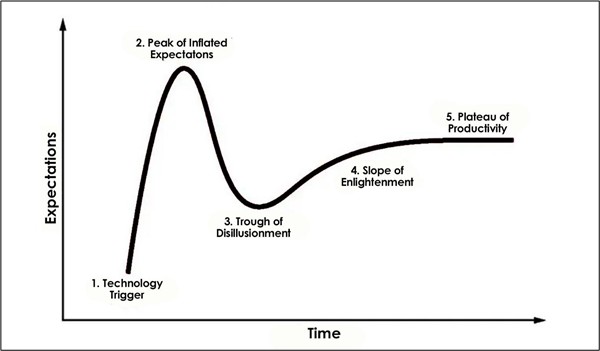
Image 1: Gartner Hype Cycle
This rhythm has been given form in what is known as the Gartner Hype Cycle, a map of how technologies rise and fall before they find their place. It begins with the spark of an innovation trigger, swells into the peak of inflated expectations, and then descends into the trough of disillusionment. From there, the survivors ascend the slope of enlightenment and, in time, rest upon the plateau of productivity. It is not a prophecy but a reminder. Hype is not random, nor new, but a pattern long observed and endlessly reiterated.
The Cost of Chasing Shadows
Hype is never harmless. Each pursuit of illusion consumes resources, diverts attention, and leaves behind debris of failed ventures. Budgets are poured into projects launched for headlines, not longevity. Talent is exhausted on research and prototypes that never mature, or worse, never came to exist. Organisations lose credibility when promises collapse into silence. The greatest cost is trust, for every failure makes technology appear less as progress and more as a theatre, dazzling in arrival yet vacant in result.
Yet even in the wreckage, not all is lost, for patterns can be read, lessons drawn and guidance found. What is needed is not another marvel but a compass that helps organisations see beyond the racket and measure technologies by their essence.
A Compass in the Noise
Amid the flood of promises and predictions, organizations search for a compass that can distinguish substance over pageantry. For in the constant churn of announcements and ambitions, it is easy to mistake frenzy for progress. Seeking clarity, organisations may look to the ThoughtWorks Technology Radar, a curated reflection on the evolving landscape of digital practice and technology. It does not offer prophecy but perspective, drawn from experience rather than press release, and opinionated enough to warn when hype outpaces substance.
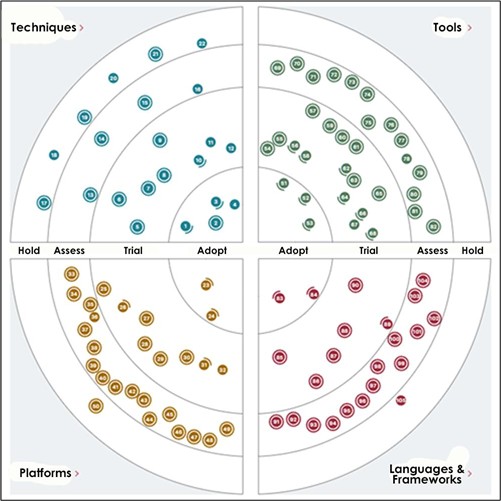
Image 2: ThoughtWorks Technology Radar — Quadrants and Rings
(Source: ThoughtWorks Technology Radar)
The Radar speaks in four rings: hold, assess, trial, and adopt. Each marks the bearing an organization might take towards a technology, from caution and vigilance to thoughtful exploration and strategic adoption. The Radar spans tools, platforms, languages, frameworks, and techniques that shape their application. In this breadth, it makes clear that technology is as much about the practice as it is about the machinery.
Anchors in the Mirage
The Radar offers a valuable reference, yet reference alone cannot steady the course. To move from observation to decision demands a method, one that tests readiness and weighs ambition against reality. Two such methods, established by practice and trusted across time, are the Technology Readiness Levels and the Adoption Readiness Levels. They do not foretell the future but act as filters, unveiling not only whether a technology is fit for usage but also whether organisations, within their own context and locality, stand ready to embrace it.
- Technology Readiness Levels (TRL) trace the journey of an idea from its first spark to its final deployment. First developed by NASA and since adopted across industries, TRL divides maturity into nine stages. It begins with the observation of basic principles and the formulation of concepts, then advances through laboratory validation, proof of concept, and testing in relevant environments. From there, prototypes are demonstrated under operational conditions until the system reaches completion, fully qualified and proven in full-scale operation. The value of TRL lies not in ceremony but in clarity, giving organisations a disciplined lens to ask a simple question: is the technology itself ready to hold its course?
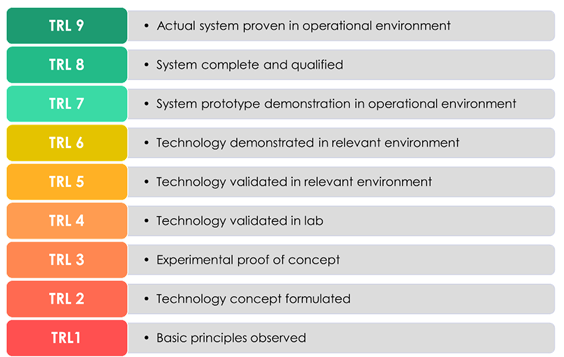
Image 3: Technology Readiness Levels (TRL 1–9)
- Adoption Technology Readiness Levels (ARL) widen the horizon from a machine to its environment. Where TRL asks whether a system is ready to stand, ARL asks whether the world around it is prepared to receive. It consists of seventeen dimensions gathered into four buckets of risk: organisational, market, technological, and regulatory. These dimensions weigh the currents of business and market, the resolve of organisations, the skill of people, as well as the guardrails of policy and law. For a technology proven in principle may yet falter if adoption finds no footing, if regulation resists, or if culture withholds its consent. The strength of ARL lies in this: readiness is not only technical but organisational, cultural, and societal, and it gains its force only when these dimensions are held in alignment.
TRL and ARL provide a discipline that counters the excesses of hype, albeit their scope may appear overwhelming when first encountered. They are not methods that must be adopted in full immediately, for their principles hold value even when applied in part. Asking if the technology is ready and if the organisation is prepared offers a glint of clarity when uncertainty lingers. From this foundation, the method can be extended gradually, and applied with greater depth as familiarity grows. Neither should it be followed in rigid imitation, for each organisation must adapt the framework to its own culture, capacity, and context. Even when employed incrementally, TRL and ARL remain anchors of discipline, ensuring ambition advances in harmony with readiness.
Clear Eyes on the Future
History is written in repetition, and amnesia is its quiet author. Each cycle begins with a gala of promises, only to dissolve before substance takes shape. In that instance, the cult of hype gathers its masses, drawn less by wisdom than by the thrill of the new. The Dunning–Kruger effect takes hold, where the least informed shine with the utmost certainty, pledging investments, declaring strategies, and building reputations long before the technology itself is fully understood. Too often it is heralded not for its worth but for the leverage it offers, championed loudly by those who have never sought to grasp its nature, wielding it as a ladder rather than as a vessel of lasting purpose. Without the bedrock of sound understanding, hype masquerades as progress and consumes trust until little remains.
In the end, even as the cycle repeats, reliable frameworks exist to guide the path ahead. References such as the Technology Radar, and structured methods like TRL and ARL, allow organisations to chart their course with better foresight. They are not flawless shields but instruments that filter noise, temper haste, and bind ambition to reason and fact. To meet the future with clear eyes is to resist the frenzy, choose patience over spectacle, and let progress advance only as far as insight allows. Hype will return, as it always has, and it need not govern the way forward. Only discipline and further comprehension can break the cycle, ensuring that technology serves not merely as cinema but as architecture built to outlast the moment. It is an architecture that endures only when pursued methodically and blended with grace that professionalism demands.
References
- (n.d.). Gartner hype cycle. Gartner. Retrieved August 22, 2025, from https://www.gartner.com/en/research/methodologies/gartner-hype-cycle
- (n.d.). Technology readiness levels. National Aeronautics and Space Administration. Retrieved August 22, 2025, from https://www.nasa.gov/directorates/somd/space-communications-navigation-program/technology-readiness-levels/
- S. Department of Energy. (n.d.). Adoption readiness levels (ARL) framework. Office of Technology Transitions. Retrieved August 22, 2025, from https://www.energy.gov/technologycommercialization/adoption-readiness-leve